
Insurance Capital and ETFs
Mainland Insurance Funds Can Invest in Hong Kong ETFs: Access Has Opened, but Flows Are Not Automatic

A wider permitted investment universe does not automatically become buying flow. The questions are how insurers select products, manage currency and liquidity risk, and whether Hong Kong's ETF market can absorb longer-duration institutional capital.
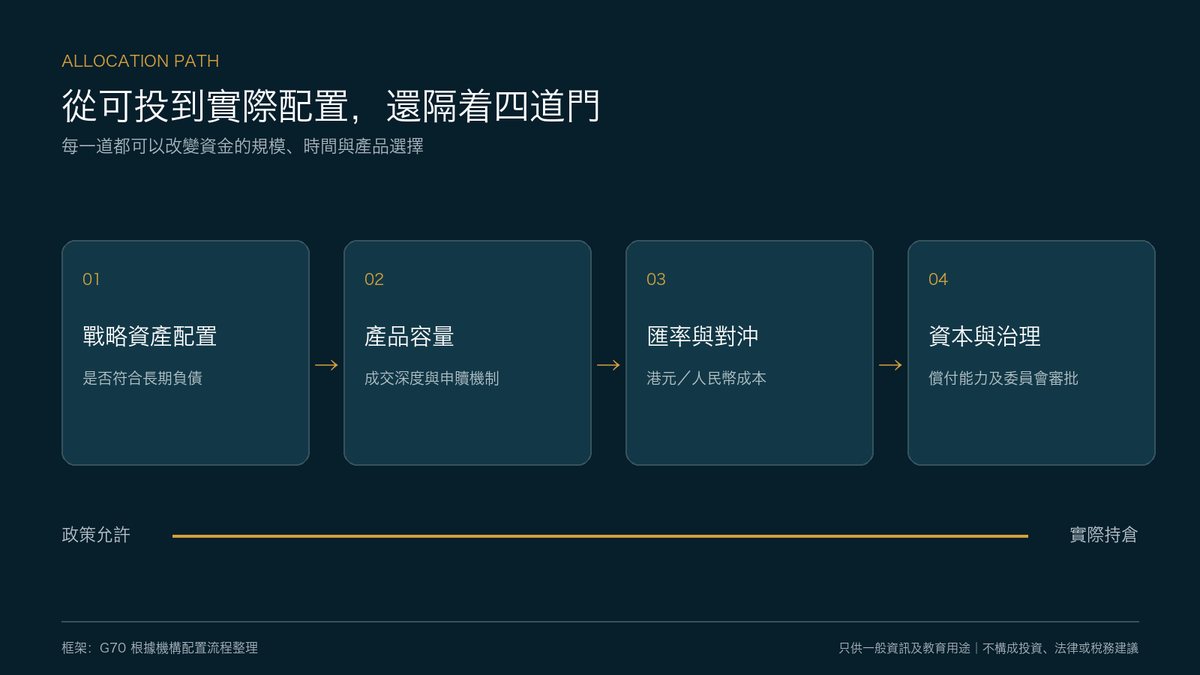
Access is only the first step; allocation still faces four gates
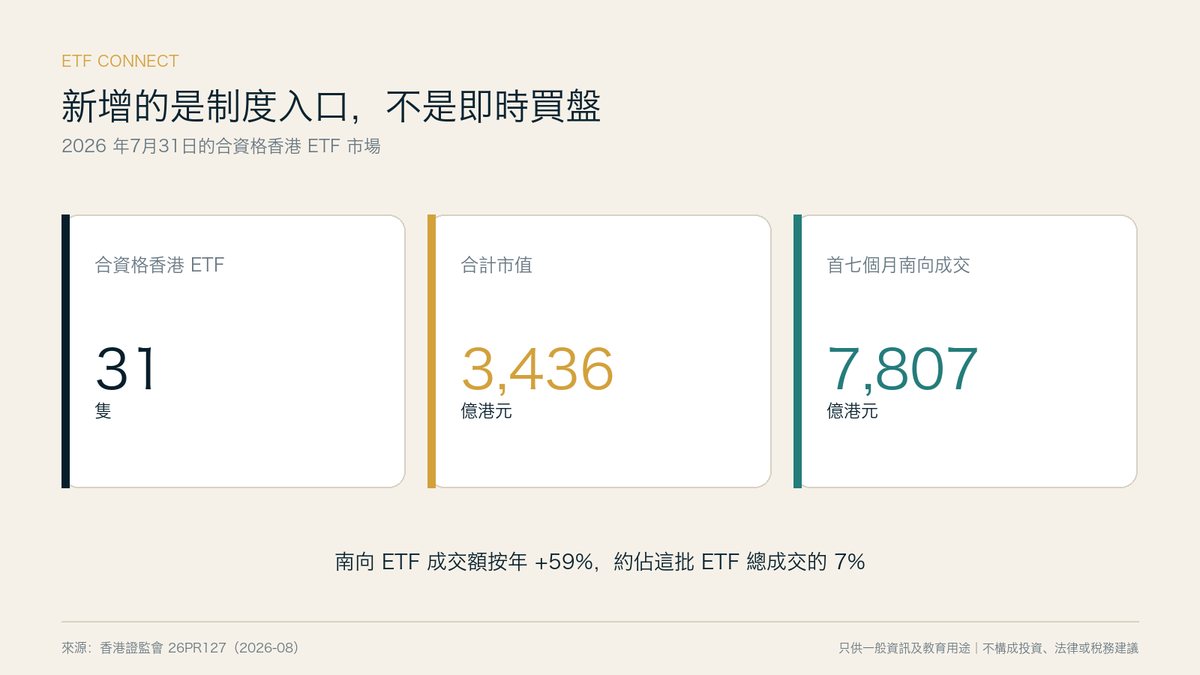
Eligible Hong Kong ETFs under Stock Connect as of July 31, 2026
Combined market capitalisation of those eligible ETFs
Southbound ETF turnover in the first seven months of 2026, up 59% year on year
What changed
In August 2026, Hong Kong's Securities and Futures Commission announced that the National Financial Regulatory Administration supports mainland insurance funds investing in eligible Hong Kong ETFs through Stock Connect. This does not open every Hong Kong ETF, nor does it require insurers to allocate. The first change is regulatory access.
As of July 31, 2026, 31 Hong Kong ETFs were eligible under southbound Stock Connect, with a combined market capitalisation of about HK$343.6 billion. Southbound ETF turnover reached about HK$780.7 billion in the first seven months of 2026, up 59% year on year and equal to roughly 7% of total turnover in those eligible ETFs.
 Open full-size image ↗
Why insurers may not move quickly
Insurers manage long-dated liabilities rather than simply pursuing short-term returns. Even with access in place, allocations must still pass asset-liability matching, solvency, internal risk limits, currency risk, tracking error, product capacity and investment-committee review.
Between permission and allocation sit at least four gates:
- whether an eligible ETF fits the insurer's strategic asset allocation;
- whether trading depth and creation-redemption capacity can support institutional size;
- whether renminbi-Hong Kong dollar currency risk and hedging costs are acceptable;
- how risk, capital usage and liability-reserve matching will be measured after investment.
 Open full-size image ↗
What could actually change in Hong Kong
If insurance capital enters gradually, the more important development may be the investor mix rather than one day's turnover. Long-term institutions tend to focus on benchmarks, scale, trading costs and portfolio transparency. That could encourage issuers to improve product design and market-making quality, while concentrating assets in a smaller group of liquid, clearly defined products.
Concentration is the other side of the story. Policy support does not benefit every ETF equally. A narrow theme, thin trading or illiquid underlying assets will not improve automatically because a new class of investor has become eligible.
G70 perspective: observe how capital enters before estimating its size
For family capital, this policy is best read as a market-structure signal: southbound investment tools are becoming more complete, and Hong Kong may play a larger role in offshore allocation by mainland long-term capital. Before treating it as an immediate liquidity catalyst, we would monitor three verifiable indicators: the number of eligible products, southbound net subscriptions and holdings, and actual allocations disclosed by insurers.
Important notice
This article is for general information and education only and does not constitute investment advice. Regulatory access does not imply any particular scale, timing or direction of fund flow.
G70 watchlist
Observe how capital enters before estimating undisclosed flows
Policy broadens the investable universe, but product selection, liability matching, liquidity and risk budgets will determine actual allocation.
- Which products genuinely fit insurers' duration and risk requirements?
- Are net subscriptions persistent rather than turnover merely increasing?
- When will asset managers and insurers disclose actual allocations?
Official and primary sources
Sources were checked on the publication date shown above. Regulations, policies and market data may subsequently change.